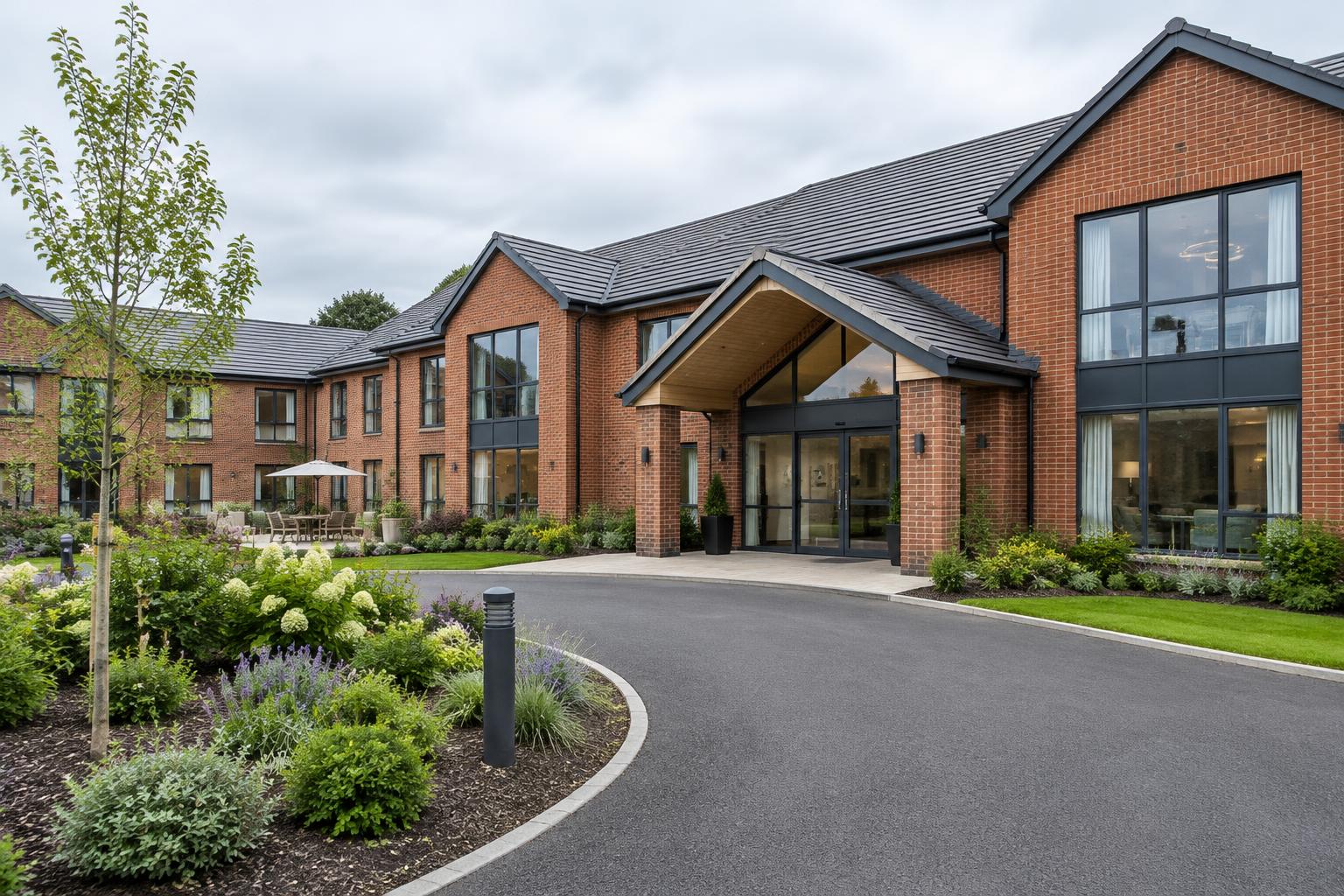
Commercial mortgages for care homes are assessed on the strength of the care business, not just the building. Lenders focus on the regulator rating, occupancy, fee income mix and the operator's experience — typically lending up to 65%–70% of value over five to twenty-five years.
At a glance
Key facts
Figures reviewed:
Typical loan-to-value
65% – 70%Up to 70% for strong trading owner-occupied homes; investor purchases up to 65%–70%, driven by lease length and operator covenant.
Typical term
5 – 25 yearsTerm depends on the operator, the property and the loan structure; interest-only and capital-repayment bases are both available.
Typical timeline to drawdown
6 – 12 weeksAssumes a complete file; valuation, legal capacity and lease review drive the critical path.
Indicative figures for guidance only, correct as at October 2026. Rates, costs and timelines vary by lender, borrower profile, asset and jurisdiction, and are not an offer of finance. Rates and terms use approved illustrative ranges, not live lender rates; a specialist confirms any product in underwriting. How we derive these figures.
How does care home finance work?
A care home mortgage is a commercial mortgage secured on a registered care home. Because the property's value depends on the trading business inside it, lenders underwrite the operator as much as the bricks and mortar: CQC rating, occupancy, the split of private and local-authority fees, and two to three years of trading accounts. Operators buying the home they run use owner-occupied commercial mortgages; landlords buying a home leased to an operator use commercial investment facilities. Clifton International arranges both as an introducer, not a lender.
Purchases, refinances and equity release for existing homes.
Limited company and SPV structures are routine.
Interest-only and capital-repayment bases are both available.
Bridging can complete first where a deadline precedes term-loan approval.
Reviewed by James Caldwell, Director, Clifton International.
Content review: 27 October 2026.
Last updated Content update only. Illustrative rate ranges are reviewed separately on the commercial mortgage calculator.
How do lenders assess a care home?
Six factors drive almost every care home lending decision. Strengthening these before an application usually matters more than shopping for a headline rate.
Regulator rating
The home's Care Quality Commission rating in England — or the equivalent regulator in Wales, Scotland or Northern Ireland — is a core part of the lending decision. Homes rated Good or Outstanding are materially easier to finance than homes requiring improvement.
Occupancy
Lenders review current and historical occupancy against local demand. Consistently high occupancy supports leverage; volatile or falling occupancy reduces it.
Fee income mix
The split between private-pay residents and local-authority-funded placements matters. Private fees are typically higher and more flexible; heavy reliance on local-authority rates can constrain affordability.
Trading accounts
Two to three years of accounts are usually required, with affordability assessed on the home's trading cash flow rather than the borrower's personal income.
Operator experience
Proven care-sector management is central to the risk assessment. First-time operators are considered but usually face lower leverage and closer scrutiny of the management team.
Property and registration
The building itself is valued as a trading concern: room count, en-suite provision, registration category and scope for extension or refurbishment all feed into value and leverage.
Operator vs investor: what changes?
Comparison of owner-occupied and investment care home mortgages
Consideration
Operator (owner-occupied)
Investor (leased to an operator)
Who borrows
The care operator buying or refinancing the home it runs
A landlord buying a care home leased to an operator
Illustrative rate range
6.5%–8.5% (owner-occupied commercial)
7%–9% (commercial investment)
Typical maximum loan-to-value
Up to 70% for strong trading homes
Up to 65%–70%, driven by lease and operator covenant
What lenders assess
CQC rating, occupancy, fee mix, trading accounts and management experience
Lease length, operator covenant strength and rental cover, plus the home's trading performance
Common structures
Limited company with directors' guarantees and a debenture over the business
SPV or company borrower with a charge over the property
Who borrows
Operator: The care operator buying or refinancing the home it runs
Investor: A landlord buying a care home leased to an operator
Illustrative rate range
Operator: 6.5%–8.5% (owner-occupied commercial)
Investor: 7%–9% (commercial investment)
Typical maximum loan-to-value
Operator: Up to 70% for strong trading homes
Investor: Up to 65%–70%, driven by lease and operator covenant
Investor: Lease length, operator covenant strength and rental cover, plus the home's trading performance
Common structures
Operator: Limited company with directors' guarantees and a debenture over the business
Investor: SPV or company borrower with a charge over the property
The table above is also available as the cards shown here.
Worked example: an operator buying a care home
An illustrative scenario using the mid-point of the approved owner-occupied commercial range and a 2% arrangement fee. This is an illustrative example, not a quote or an offer of finance; the rate a lender offers comes down to the loan size and the risk profile of the business, confirmed in underwriting.
Try your own figures for a care home purchase or refinance. The illustration allows up to 70% loan-to-value, in line with typical care home lending, and uses the approved owner-occupied or investment range.
Indicative monthly payment
£10,472.71
Illustrative rate
7.50% (6.5%–8.5%)
Loan-to-value
65.0% (max 70%)
Arrangement fee, paid separately
£26,000
Illustrative only, not a quote or offer of finance. Uses the mid-point of an approved lender-neutral range; the rate a lender offers depends on loan size and the business's risk profile, confirmed in underwriting.
Care and healthcare businesses are assessed in similar ways. This case is summarised from Clifton Private Finance's published account — it is not a Clifton International transaction, and its historical rates and fees are intentionally not reproduced.
£2m commercial mortgage · 15-year term · single charge on the London property
Clifton Private Finance’s January 2025 account reports a £2m owner-occupied commercial mortgage refinancing for a healthcare business operating from multiple UK sites: existing portfolio debt was consolidated into a single facility secured on the London property, leaving two offices unencumbered.
These are reported outcomes for the clients concerned. Lender criteria and individual circumstances vary, so the same result is not guaranteed. Property images are illustrative and do not show the clients' own homes.
Yes. Care home mortgages are available for operators buying the home they run (owner-occupied) and for investors buying a home leased to a care operator (investment). Clifton International arranges both as an introducer, not a lender.
Typically up to 65%–70% loan-to-value, with experienced operators and strong trading accounts sometimes achieving more. Loan sizes usually start around £250,000 and can extend into the millions for larger homes and groups.
Lenders look beyond the bricks and mortar: the home's CQC rating (or the equivalent regulator in Wales, Scotland or Northern Ireland), occupancy levels, the mix of private and local-authority fee income, two to three years of trading accounts, and the operator's experience and track record. The rate a lender offers comes down to the loan size and the risk profile of the business, confirmed in underwriting.
Most lenders want proven care-sector management experience, because the business's trading performance drives the lending decision. First-time operators can be considered but usually face lower leverage, a larger deposit and closer scrutiny of the management team.
Yes. Refinancing can consolidate existing borrowing, fund refurbishment or extension, or release equity for further acquisitions. Lenders will reassess occupancy, fee income and inspection ratings at the point of application.
Illustrative rate scenarios approved by Clifton International run from 6.5% to 8.5% for owner-occupied commercial property and 7% to 9% for commercial investment; care homes sit within these ranges depending on the strength of the case. These are illustrative scenarios, not live lender rates, and no lender is named. The rate a lender offers comes down to the loan size and the risk profile of the business, confirmed in underwriting.
Yes. Purchases through a limited company or SPV are routine in the care sector, and lenders typically take personal guarantees from the directors alongside a charge over the property and, for trading homes, a debenture over the business.