
At a glance
Key facts
Figures reviewed:
- Typical LTV (French non-resident)
- 60–70%Of the lower of purchase price or tasación valuation.
- Indicative fixed rates
- Approx. 2.80% – 3.90% p.a.Indicative non-resident pricing from Clifton International's Spanish lender panel, reviewed July 2026. Not a rate offer.
- Indicative mixed rates
- Approx. 2.50% – 3.40% p.a. initial period
- Variable margin
- 12-month Euribor + 0.90% – 1.75%
- Affordability test
- c.35% of gross incomeIncludes an existing prêt immobilier and all worldwide debt service.
- Acquisition costs
- 10–14% of priceITP 6–10% on resale; 10% IVA plus 1.2–1.5% AJD on new build.
- Typical timeline
- 6–8 weeks10–12 weeks for SCI or corporate structures. Where speed is required consider short term bridging finance to secure the property.
- Non-resident income tax
- 19% IRNR (EU rate)
Indicative figures for guidance only, correct as at July 2026. Rates, costs and timelines vary by lender, borrower profile, asset and jurisdiction, and are not an offer of finance. How we derive these figures.
Methodology and assumptions
- Figures are compiled by Clifton International specialists from live lender term sheets, indicative quotes and completed transactions arranged over the preceding 12 months.
- Rates and costs are stated as ranges rather than a single number because pricing is set case-by-case on borrower profile, residency, asset type, location and loan-to-value.
- Timelines assume a complete document file from the outset; valuation, legal capacity and (in Spain) NIE and notary availability drive the critical path.
- Costs exclude any lender, broker or third-party fees not stated on the page, and exclude currency movement between agreement and drawdown.
- Figures are reviewed at least quarterly and re-checked against lender pricing whenever a material market change occurs.
Last reviewed . Read the full Key facts methodology, or speak to our team for a quote based on your circumstances.
Can French residents get a mortgage in Spain?
Yes. French residents can borrow against Spanish property as EU non-residents. Euro income and EU residency give access to the top loan-to-value band — typically 60–70% of purchase price or valuation, whichever is lower — across the broadest Spanish lender panel, with a full application usually completing in six to eight weeks.
- 60–70% LTV for CDI employees, fonctionnaires, chefs d'entreprise and professions libérales.
- An existing prêt immobilier counts in the c.35% debt-service test but rarely blocks a second facility.
- No currency risk — income and loan are both euro-denominated.
- The Spanish property falls within the French IFI, with treaty relief against Spanish Patrimonio.
Key takeaways
- French residents can typically borrow to 60–70% LTV as EU non-residents.
- EUR income and no currency risk mean the widest available lender panel.
- Existing French mortgage debt (résidence principale) is included in Spanish affordability tests.
- Costa Brava and Barcelona are the busiest hotspots — French-speaking relationship managers are common in local branches.
- Cross-border tax planning across France and Spain is essential to avoid double reporting.
French buyers versus non-EU buyers in Spain
EU residency and euro income are the two factors that most widen the Spanish lender panel.
| Factor | French buyer | Non-EU buyer (US / GCC) |
|---|---|---|
| Typical LTV | 60–70% | 50–65% |
| Lender pool | Broad — most Spanish retail banks | Narrow — international desks only |
| Income currency | EUR, no discount | USD/AED, discounted 10–30% |
| Non-resident income tax (IRNR) | 19% (EU rate) | 24% |
| Typical timeline | 6–8 weeks | 8–12 weeks |
Swipe the table sideways to see all columns.
Indicative figures only. Actual terms depend on borrower profile, asset and lender criteria.
How much can French buyers borrow?
Non-resident LTVs generally cap at 70% for EU residents on residential purchases. French applicants — whether CDI employees, functionnaires, chefs d'entreprise or professions libérales — regularly reach this ceiling subject to affordability.
Total worldwide debt service is stress-tested to c.35% of gross monthly income. A prêt immobilier on the résidence principale is factored in, but favourable long-term French fixed rates usually leave meaningful room for a Spanish facility.
Documents required
- Carte nationale d'identité or passeport, plus NIE.
- Last 3 bulletins de salaire and last 2 avis d'imposition.
- Self-employed: 2–3 years liasse fiscale / bilans plus URSSAF confirmations.
- Last 6 months of relevés de compte (all current and savings accounts).
- Tableau d'amortissement of any existing prêt immobilier.
- Sworn Spanish translation for statutory documents.
Cross-border tax considerations
- France and Spain have a double-tax treaty; Spanish rental income is taxed in Spain first, with credit available in France.
- Non-resident owners pay Spanish IRNR at 19% (EU rate) on rental income and imputed income.
- IFI (Impôt sur la Fortune Immobilière) in France applies to the Spanish property's net value.
- Spanish regional wealth tax (Patrimonio) applies in Catalonia, Balearics and some other regions.
- SCI ownership is possible but narrows the lender panel and does not always improve tax efficiency.
The end-to-end process
- Week 1–2: Fact-find, indicative terms from an EU-friendly lender panel.
- Week 2–3: NIE, formal application, opening underwriting.
- Week 3–5: Tasación and credit committee approval.
- Week 5–7: FEIN/FiAE offer; 10-day cooling-off period.
- Week 7–8: Notary and escritura pública.
Where French buyers purchase
Proximity keeps Catalonia — Girona, the Costa Brava and Barcelona — the busiest French corridor, reachable by road and by frequent AVE and TGV connections. The Costa del Sol and Balearics take the higher-value end, and the Costa Blanca attracts value-led second-home buyers.
Lender appetite tracks the asset rather than the buyer: rural properties on suelo rústico, homes without a current cédula de habitabilidad and off-plan new builds each need specific lender selection, while touristic-licensed apartments are underwritten as investment stock.
Bridging, SCI structures and renovation finance
Where a Spanish purchase must complete before a French property sells, short-term bridging secured on the Spanish asset is the usual solution — indicatively 0.7–0.9% per month to a maximum 65% LTV, with a documented exit through sale or refinance onto a term mortgage.
French buyers frequently ask about replicating an SCI in Spain. The nearest equivalent is a Spanish SL, and a French SCI can hold Spanish property, but both narrow the lender panel, require full UBO disclosure, and change succession and wealth-tax treatment on both sides. Renovation and subdivision projects move into development finance, assessed on loan-to-cost and loan-to-GDV with the licencia de obra as the gating item.
Purchase costs and cash required
Budget 10–14% of the purchase price in acquisition costs on top of the deposit — broadly comparable to French frais de notaire on an ancien property, but composed differently. On a resale the main item is regional ITP transfer tax at 6–10%; new builds attract 10% IVA plus 1.2–1.5% AJD.
- Notary and land registry: c.0.5–1%.
- Legal fees: c.1% plus VAT, typically with a French-speaking abogado.
- Lender arrangement fee: 0.5–1.5%; tasación €400–€900.
- Ongoing: IBI, community fees, IRNR filings and, in some regions, Patrimonio wealth tax.
On a €700,000 Costa Brava resale at 65% LTV, plan on roughly €245,000 deposit plus €77,000–€98,000 of costs.
What rate will a French buyer pay?
French applicants price on the standard Spanish non-resident grid. Indicative fixed pricing is 2.80% – 3.90% p.a. over 10–25 years, mixed products open at 2.50% – 3.40% p.a. for the initial fixed period, and variable products track 12-month Euribor plus 0.90% – 1.75%.
Unlike a French prêt immobilier, Spanish pricing is not driven by an assurance emprunteur bundled at origination; buildings cover is required and life cover is optional and often cheaper arranged separately. Bundled products can cut the margin — compare total cost rather than the headline discount. Indicative non-resident pricing from Clifton International's Spanish lender panel, reviewed July 2026. Not a rate offer.
A Spanish purchase case study
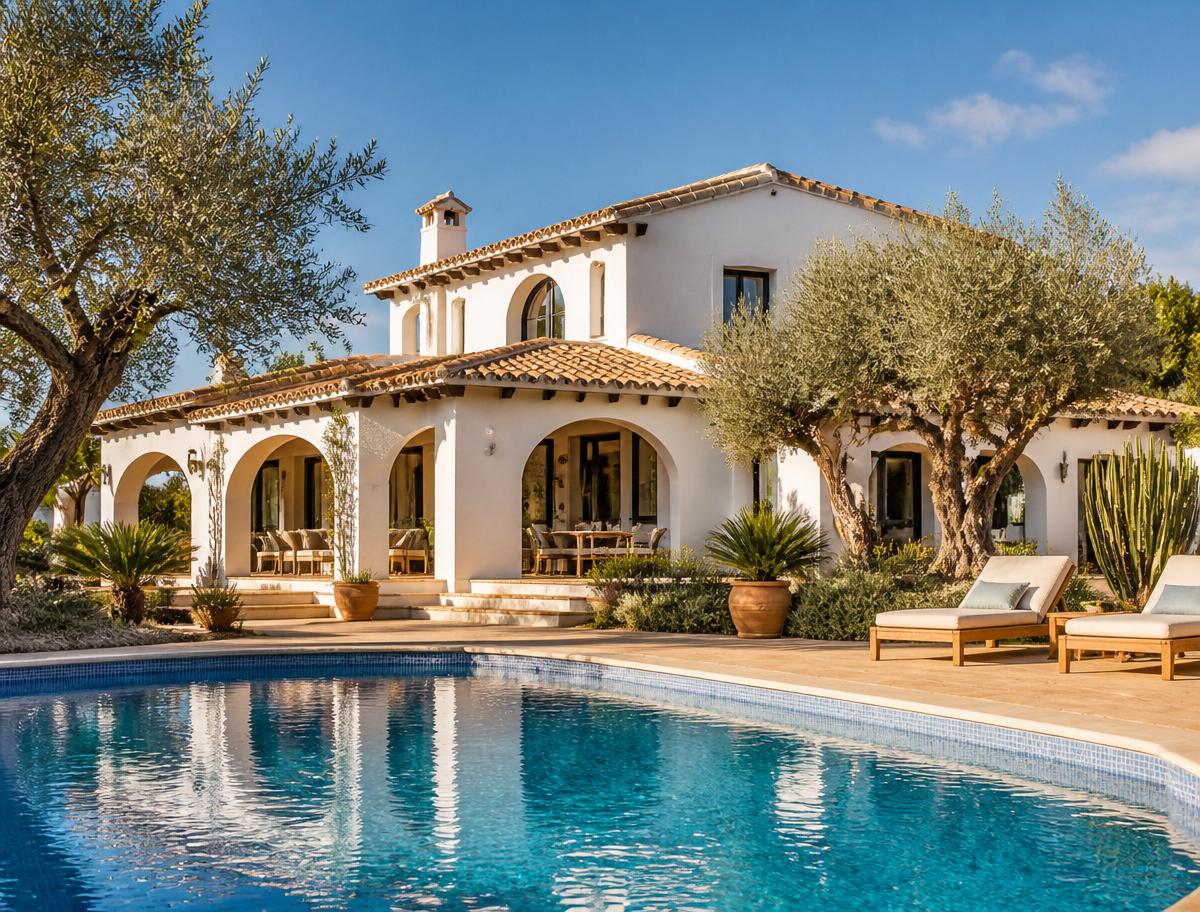
Below market value bridge purchase, Javea
€300k bridge · 12-month term · interest retained
UAE-based British citizens needed short-term funding to secure a holiday home in Javea at below market value, with the intention to refinance onto a longer-term mortgage once the purchase completed.
We introduced a Spain-based private funder who provided a 12-month bridge, structured against the estimated open-market value and with a clear refinance exit.
- Completed inside the vendor's deadline before the buyer's home sale
- Refinanced onto a term Spanish mortgage once underwriting completed
- Illustrates the bridge-then-term route where a French sale runs late
Five mistakes that cost French buyers time
- Leaving the NIE too late. It gates the application, the bank account and the notary.
- Expecting a French-style offre de prêt timetable. Spain runs a FEIN/FiAE process with a statutory 10-day cooling-off period.
- Assuming an SCI is neutral. It narrows the lender panel, adds UBO disclosure and changes wealth and succession treatment on both sides.
- Overlooking the cédula de habitabilidad. Missing paperwork triggers a valuation haircut or a decline.
- Signing a reserva with no finance condition. Without a subject-to-mortgage clause the deposit is at risk.
Frequently asked
Questions from readers
Do French buyers get better LTVs than UK buyers in Spain?
Yes. As EU residents, French buyers typically access 60–70% LTV, versus 60–65% for UK residents post-Brexit, and 50–65% for US or Middle-East buyers.
Can I keep my French mortgage running while I take a Spanish one?
Yes. Your existing prêt immobilier is factored into Spanish affordability, but is generally not an obstacle to a second facility.
Will my French bank lend against Spanish property?
A handful of large French groups (BNP, Crédit Agricole, Société Générale) operate in Spain, but you're not obliged to use them — Spanish lenders often price more competitively for non-resident deals.
Is there a currency-conversion risk?
No. Both income and loan are in euros, so the EU Mortgage Credit Directive currency provisions don't apply.
How long does completion take?
6–8 weeks for a well-prepared French file. SCI or corporate structures extend to 10–12 weeks.
What deposit do French buyers need?
Plan on 30–40% of the purchase price plus 10–14% in taxes and acquisition costs. On a €700,000 Costa Brava resale at 65% LTV that is around €245,000 deposit and €77,000–€98,000 of costs.
Can I hold Spanish property through an SCI?
Yes, and a Spanish SL is the closer local equivalent. Both narrow the lender panel, require full beneficial-ownership disclosure and change succession and wealth-tax treatment in France and Spain — take advice on both sides before structuring.
Can I bridge a Spanish purchase before my French property sells?
Yes. Bridging secured on the Spanish asset is common where the completion deadline precedes a sale — indicatively 0.7–0.9% per month to a maximum 65% LTV with a documented exit.
How does Spanish property affect the IFI?
Spanish real estate held by a French tax resident is within the scope of the impôt sur la fortune immobilière, and regional Spanish Patrimonio may also apply. The Franco-Spanish treaty prevents double taxation but both filings can be required.
Is interest-only available in Spain?
Rarely on retail non-resident terms, which are capital and interest. Interest-only is realistic through international private banks, generally above €1m and with an assets-under-management relationship.
Do I need a Spanish bank account and insurance?
Yes to the account — mortgage, IBI, community fees and utilities are collected by direct debit. Buildings insurance is required by lenders; life cover is optional but usually priced into the Spanish offer and often cheaper arranged separately.
What rate will I pay as a French non-resident?
Indicative non-resident pricing is 2.80% – 3.90% p.a. fixed over 10–25 years, 2.50% – 3.40% p.a. for the initial period on a mixed product, or 12-month Euribor plus 0.90% – 1.75% on a variable. Indicative non-resident pricing from Clifton International's Spanish lender panel, reviewed July 2026. Not a rate offer.
Can I complete without travelling to Spain?
Yes. A procuration signed before a French notaire and apostilled lets your Spanish abogado sign the escritura on your behalf, which most French buyers prefer to a second trip.
Do I need a separate assurance emprunteur in Spain?
No. Buildings insurance is required by lenders; life cover is optional in Spain and, unlike a French prêt immobilier, is not a condition of the offer — though bundling it can reduce the margin. Compare the total cost either way.
How does Spanish succession tax interact with French rules?
Spanish ISD is charged where the property is situated and French succession rules can also apply to a French tax resident's estate, with treaty and credit relief available. A Spanish will limited to Spanish assets makes administration far simpler.